Rebuilding After Wildfires in Los Angeles County
Wildfires have wreaked havoc on countless homes and businesses across Los Angeles County, leaving property owners struggling to...
Read more

 Contact Us Now



If you’ve been injured in a car accident in Fallbrook or anywhere in California, one of the most critical questions on your mind is likely: “How much time do I have?” Understanding California’s statute of limitations for car accident claims is essential to protecting your legal rights and ensuring you don’t forfeit your ability to seek compensation.
The short answer is that you generally have two years from the date of the accident to file a personal injury lawsuit in California. However, the reality is more nuanced, and missing these deadlines can have devastating consequences for your case. As a Fallbrook car accident attorney, I’ve seen too many injured victims wait too long and lose their right to compensation entirely.
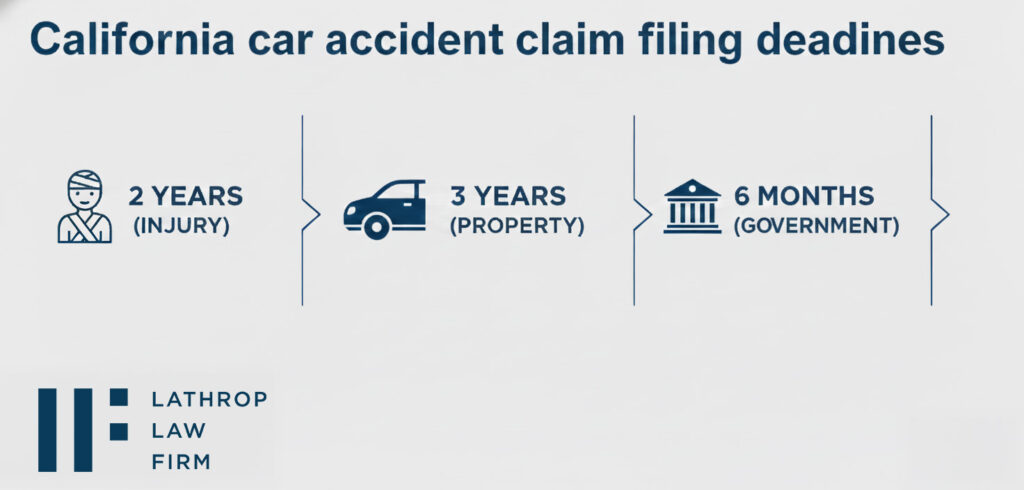
California law establishes specific time limits for filing different types of claims arising from car accidents:
Personal Injury Claims: 2 Years
If you were injured in a car accident, you have two years from the date of the accident to file a lawsuit against the at-fault driver. This applies to injuries ranging from minor whiplash to catastrophic injuries like spinal cord damage or traumatic brain injuries.
Property Damage Claims: 3 Years
For damage to your vehicle or other property, you have three years from the date of the accident to file a lawsuit. This longer timeline recognizes that property damage claims are often more straightforward than personal injury cases.
Wrongful Death Claims: 2 Years
If your loved one died as a result of a car accident, you have two years from the date of death (not necessarily the date of the accident) to file a wrongful death lawsuit. This tragic situation requires compassionate legal guidance to navigate both the emotional and legal complexities.
These deadlines are not suggestions—they are strictly enforced by California courts. If you miss the deadline, even by a single day, the court will almost certainly dismiss your case, and you’ll lose your right to seek compensation regardless of how strong your case might have been.
While the two-year statute of limitations applies in most cases, California law recognizes several important exceptions:
The Discovery Rule
In some cases, injuries from a car accident may not become apparent immediately. For example, some back injuries, internal organ damage, or certain psychological injuries may not manifest symptoms until weeks or months after the accident. In these situations, the “discovery rule” may apply, starting the two-year clock from the date you discovered (or reasonably should have discovered) the injury rather than the accident date itself.
However, don’t rely on this exception to delay action. Insurance companies and defense attorneys will aggressively challenge discovery rule claims, and the burden of proof falls on you to demonstrate when you actually discovered the injury.
Minors Have Extended Time
If the injured party is under 18 years old at the time of the accident, the statute of limitations doesn’t begin until they turn 18. This means a minor has until their 20th birthday to file a personal injury lawsuit for a car accident that occurred when they were a child. This extended protection exists because minors cannot legally file lawsuits on their own behalf.
Defendant Left California
If the at-fault driver leaves California for a substantial period after the accident, the time they spend out of state may not count toward the statute of limitations. This “tolling” provision prevents defendants from running out the clock by avoiding the state.
Mental Incapacity
If you were mentally incapacitated at the time of the accident or became incapacitated afterward, the statute of limitations may be tolled until the incapacity ends. However, proving legal mental incapacity requires substantial medical documentation.
If your car accident involved a government employee or occurred due to a dangerous road condition maintained by a government agency, you face a drastically shorter timeline. In California, you must file a claim with the appropriate government agency within just six months (180 days) of the accident.
This applies to accidents involving:
For example, if you were injured in an accident on Highway 76 in Fallbrook due to a poorly maintained road surface or inadequate signage, you would need to file a claim against Caltrans or the appropriate government entity within six months. Missing this deadline is even more fatal than missing the standard two-year deadline, as courts rarely grant extensions.
After filing the government claim, if it’s denied or ignored for 45 days, you then have six months from the denial (or one year from the original accident date, whichever comes first) to file a lawsuit. The complexity of these government claim procedures makes it essential to consult with an experienced attorney immediately after any accident involving a government entity.
Even though you technically have two years to file a lawsuit, waiting anywhere close to that deadline puts your case at serious risk. Here’s why you should act quickly:
Evidence Disappears
Physical evidence from the accident scene deteriorates or vanishes. Skid marks fade, debris gets cleared, damaged vehicles get repaired or scrapped, and accident scenes change. In one case I handled involving an accident at Mission Road and Ammunition Road in Fallbrook, we were able to secure crucial surveillance footage from a nearby business—but only because the client contacted us within two weeks. By 60 days, that footage would have been automatically overwritten and lost forever.
Witnesses’ Memories Fade
Witness testimony becomes less reliable over time. People forget details, move away, or become harder to locate. What seemed crystal clear to a witness one week after the accident becomes fuzzy and uncertain six months later. Insurance companies know this and will exploit inconsistencies in delayed witness statements.
Medical Records Become Harder to Obtain
Hospitals and medical providers typically maintain records for a limited time. While major hospitals keep records for years, smaller clinics, urgent care facilities, and private practices may purge records after shorter periods. Obtaining complete medical documentation becomes progressively more difficult as time passes.
Insurance Company Pressure Tactics
Insurance adjusters use delay against you. If you wait months to hire an attorney or assert your rights, adjusters will argue that your injuries must not be serious or that you’ve already recovered. They’ll pressure you to accept lowball settlements by suggesting that your delay indicates you don’t have a strong case.
Your Own Memory Fades
Your recollection of the accident details will naturally become less precise over time. The sequence of events, exact timing, weather conditions, traffic patterns, and other crucial details become fuzzy. This can hurt your credibility when you’re eventually deposed or testify.
Life Gets in the Way
Clients often tell me they intended to pursue their case but got busy with work, family obligations, medical treatments, or other life events. Before they knew it, a year or more had passed. Don’t let this happen to you—take action while the accident and your injuries are still fresh.
It’s important to understand that filing an insurance claim is different from filing a lawsuit, and they operate on different timelines:
Insurance Claims
You should report an accident to your insurance company immediately—typically within 24 hours. Your insurance policy likely requires “prompt” notification, and delays can give the insurer grounds to deny coverage. However, you don’t need to provide a detailed recorded statement or accept any settlement offer right away.
For the at-fault driver’s insurance company, there’s no strict legal deadline for filing a claim, but practical considerations make speed essential. The sooner you file, the fresher the evidence and the stronger your position.
Lawsuits
The two-year statute of limitations applies to filing an actual lawsuit in court, not to filing an insurance claim. Most car accident cases settle through insurance negotiations without ever filing a lawsuit. However, you need to be prepared to file that lawsuit as the two-year deadline approaches if settlement negotiations aren’t progressing favorably.
Here’s the strategic reality: having an attorney who’s prepared to file a lawsuit significantly strengthens your negotiating position with insurance companies. They know that if they don’t make a reasonable settlement offer, you have the option to take them to court. But that leverage evaporates as the statute of limitations deadline approaches.

If you attempt to file a lawsuit after the statute of limitations has expired, the defendant will file a motion to dismiss based on the untimely filing. The court will grant this motion, and your case will be over before it even begins. No matter how strong your evidence, how severe your injuries, or how clearly the other driver was at fault, the court lacks the authority to hear your case once the deadline has passed.
There are extremely rare circumstances where courts may grant equitable relief, but these situations are so exceptional that you should never count on them. For practical purposes, missing the statute of limitations means permanently forfeiting your right to compensation.
The consequences are particularly harsh because insurance companies know about these deadlines and will often intentionally drag out negotiations, hoping you’ll miss the deadline. Once the statute of limitations expires, they have no incentive to offer you anything at all.
If you’ve been in a car accident in Fallbrook or anywhere in California, take these steps immediately:
Document Everything Today
Take photographs of your injuries, your damaged vehicle, and the accident scene if you haven’t already. Write down everything you remember about the accident while the details are fresh. Keep a journal tracking your pain levels, medical appointments, and how the injuries affect your daily life.
Seek Medical Care Immediately
Even if you feel fine or your injuries seem minor, get evaluated by a medical professional. Some serious injuries don’t present immediate symptoms, and gaps in medical treatment give insurance companies ammunition to minimize your claim. Follow your doctor’s treatment plan and attend all follow-up appointments.
Preserve All Evidence
Keep every document related to the accident: the police report, medical bills, prescription receipts, repair estimates, correspondence with insurance companies, and pay stubs showing lost wages. Don’t throw anything away—what seems insignificant now might be crucial later.
Don’t Give Recorded Statements
While you should report the accident to your insurance company, you’re not required to give a detailed recorded statement to the at-fault driver’s insurance company without legal representation. These statements are designed to trap you into saying something that can be used to minimize or deny your claim.
Consult with an Attorney Promptly
The sooner you consult with an experienced personal injury attorney, the better protected your rights will be. Initial consultations are typically free, and most personal injury attorneys work on contingency—meaning you pay nothing unless they recover compensation for you.
Some people hesitate to contact an attorney, thinking they should “wait and see” how their injuries develop or whether the insurance company will make a fair offer. This wait-and-see approach often backfires. Here’s what an attorney can do for you early in the process:
An experienced attorney can immediately begin preserving evidence, including sending preservation letters to prevent surveillance footage from being deleted and securing witness statements while memories are fresh. We can handle all communication with insurance companies, protecting you from giving damaging statements or accepting inadequate settlement offers. We can connect you with qualified medical providers if you need treatment and arrange for deferred payment until your case settles.
Most importantly, we can accurately evaluate the full value of your claim, including future medical expenses and long-term impacts that you might not have considered. Insurance companies routinely make lowball offers to unrepresented accident victims, knowing that most people don’t understand the true value of their claims.
If your accident occurred in Fallbrook, several local factors affect the timeline and handling of your case:
Accidents on state highways like Highway 76 or Interstate 15 may involve Caltrans (California Department of Transportation) if road conditions contributed to the accident. These cases trigger the six-month government claim deadline and require specific procedural steps.
The San Diego County Sheriff’s Department typically responds to accidents in Fallbrook, and obtaining complete police reports may take several weeks. Don’t wait for the police report to contact an attorney—we can obtain it for you and begin investigating your case in the meantime.
Local medical facilities including Fallbrook Hospital and nearby urgent care centers provide necessary treatment, but coordinating medical documentation from multiple providers requires organization. We can help ensure all your treatment is properly documented to support your claim.
The statute of limitations exists to encourage prompt action and ensure that cases are decided based on reliable evidence. While two years might seem like plenty of time, the reality is that building a strong case takes time, and delay only weakens your position.
If you’ve been injured in a car accident in Fallbrook or anywhere in North San Diego County, don’t wait to protect your rights. Every day you delay is a day that evidence fades, witnesses become harder to locate, and your bargaining position weakens.
As a bilingual attorney practicing in Fallbrook, I’ve helped numerous families recover fair compensation after devastating accidents. I understand the challenges you’re facing—the medical bills, lost wages, pain and suffering, and uncertainty about the future. I’m here to help you navigate this difficult time and fight for the compensation you deserve.
Don’t let the statute of limitations expire and forfeit your right to compensation. Contact Lathrop Law today for a free consultation. We’ll review your case, explain your legal options, and help you understand exactly how much time you have to take action.
Time is not on your side. Call us today, and let’s discuss how we can help you move forward. Whether you speak English or Spanish, we’re here to fight for your rights and the compensation you deserve.