Rebuilding After Wildfires in Los Angeles County
Wildfires have wreaked havoc on countless homes and businesses across Los Angeles County, leaving property owners struggling to...
Read more

 Contact Us Now

Being involved in a helicopter crash or aviation accident is one of the most traumatic experiences imaginable. As a helicopter crash lawyer serving Fallbrook, I’ve seen how these catastrophic events devastate families and leave survivors facing overwhelming medical bills, lost income, and emotional trauma. Unlike typical vehicle accidents, helicopter crashes often result in severe injuries or fatalities, requiring specialized legal expertise to protect your rights against powerful aviation companies and their insurance carriers.
Helicopter crashes in our area typically involve medical transport flights to Palomar Medical Center or agricultural operations in the rural hills surrounding Fallbrook. The unique geography of North San Diego County, with its rolling terrain and changing weather patterns from coastal fog to inland heat, creates specific aviation hazards that contribute to these tragic accidents.
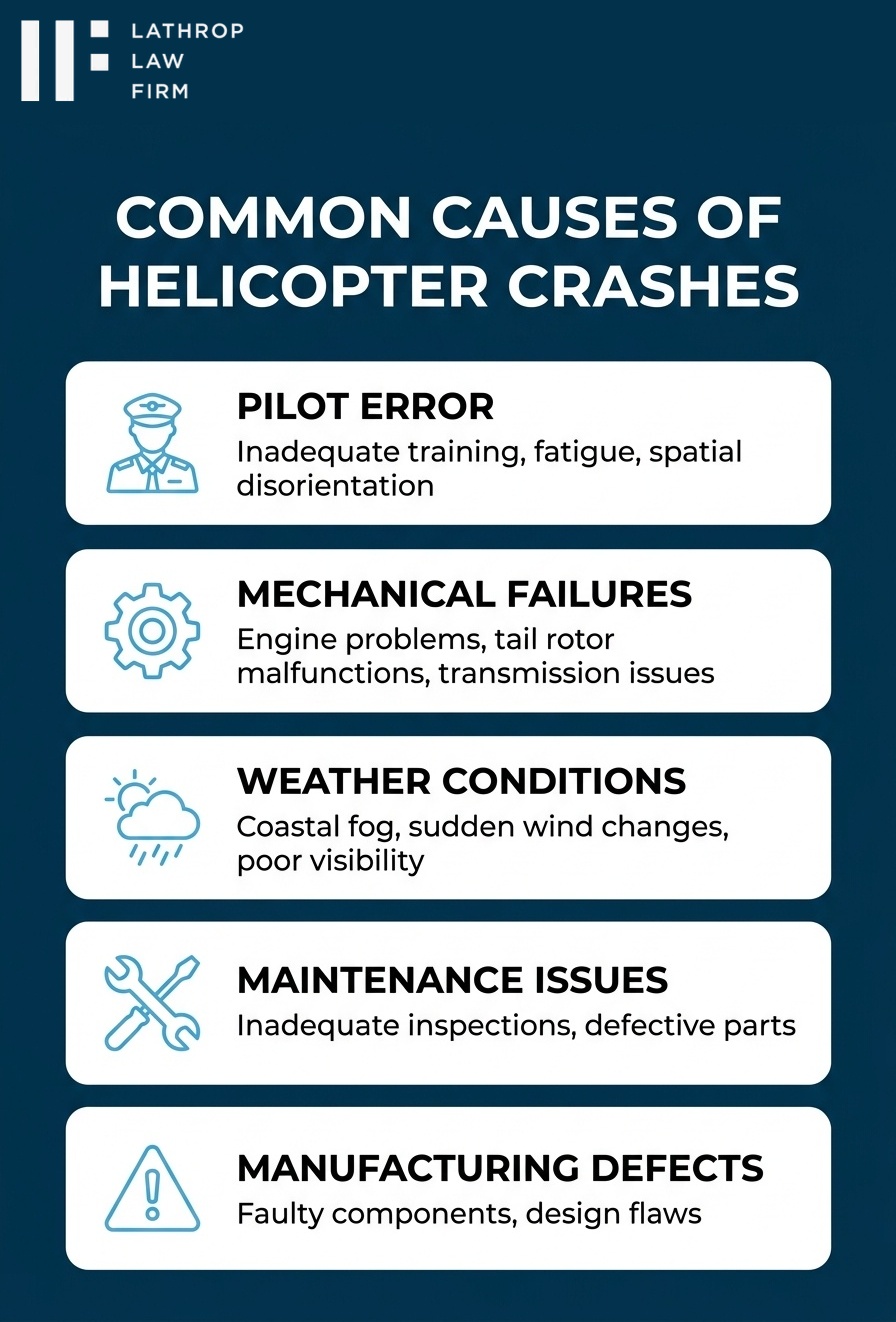
Understanding what causes helicopter accidents is crucial for establishing liability and securing compensation. The most frequent causes I encounter include:
Pilot Error
Pilot mistakes account for a significant percentage of helicopter crashes. This includes inadequate training, fatigue, spatial disorientation, or poor decision-making regarding weather conditions. Under Federal Aviation Regulation Part 61, helicopter pilot requirements vary significantly depending on the operation type, and many pilots lack sufficient experience for challenging conditions.
Mechanical Failures
Helicopters have thousands of moving parts that must function perfectly for safe flight. Engine failures, tail rotor malfunctions, transmission problems, or blade defects can cause catastrophic crashes. These mechanical issues often stem from inadequate maintenance under Federal Aviation Regulation Part 145, defective parts, or manufacturing defects covered by product liability law.
Weather-Related Factors
The hills and valleys around Fallbrook create microclimates that change rapidly. Morning fog rolling in from the coast near Rainbow or sudden wind shear can catch pilots unprepared. Flying in conditions beyond the pilot’s capabilities or aircraft limitations violates Federal Aviation Regulation Part 91.13 regarding careless and reckless operation.
Maintenance Negligence
Federal Aviation Administration regulations under Part 43 require strict maintenance schedules for helicopters. When operators cut corners to save money or fail to follow proper inspection protocols, mechanical failures become inevitable. Poor record-keeping can mask developing problems until they become catastrophic.
Different helicopter operations present unique risks and liability issues. The most common helicopter activities in our area include:
Emergency Medical Services
Medical helicopters transport critically injured patients from accident scenes along Highway 76 or Interstate 15 to trauma centers. These flights operate under intense time pressure, sometimes in challenging weather conditions. When EMS helicopter crashes occur, multiple parties may be liable under California Civil Code Section 1714, including the helicopter operator, medical transport company, hospital, and aircraft manufacturer.
Agricultural Operations
Helicopters spray crops and manage livestock on farms throughout the Fallbrook area. These low-altitude operations involve frequent takeoffs and landings near power lines and obstacles. Agricultural helicopter accidents frequently involve pilot fatigue from long hours during growing seasons, creating liability under California Labor Code provisions regarding pilot duty time.
Recreational and Tourism Flights
Tourist flights to nearby areas or scenic tours of North County operate from small airfields. These recreational flights may involve less experienced pilots or inadequately maintained aircraft. Tour companies sometimes prioritize profits over safety, operating with minimal safety margins in violation of Federal Aviation Regulations.
Aviation accident cases involve complex liability issues requiring thorough investigation. Consider a situation where a medical helicopter crashes while transporting a patient from Mission Avenue to Palomar Medical Center due to mechanical failure. The investigation might reveal inadequate maintenance by the operator, defective parts from the manufacturer, or pilot error in continuing flight despite warning indicators. Each scenario creates different liability theories under California tort law and federal aviation regulations.
Potential defendants in helicopter crash cases include:
Helicopter Operators and Pilots
The pilot and operating company can be held liable for negligent operation under California Civil Code Section 1714, inadequate training, or violations of Federal Aviation Regulations. This includes flying in unsafe weather conditions, exceeding weight limits under Federal Aviation Regulation Part 23, or failing to conduct proper pre-flight inspections.
Maintenance Companies
Third-party maintenance providers who service helicopters may be liable for negligent repairs, inadequate inspections, or failure to follow manufacturer specifications under Federal Aviation Regulation Part 145. Maintenance-related crashes I handle often involve falsified records or shortcuts that compromise safety.
Aircraft and Parts Manufacturers
When defective design or manufacturing causes a crash, the helicopter manufacturer or component suppliers face liability under California Civil Code Section 1714.45 product liability theories. These cases require complex engineering analysis and expert testimony to prove design defects or manufacturing flaws.
Government Entities
If air traffic control errors, inadequate runway maintenance, or faulty navigation equipment contributed to the crash, government agencies may bear responsibility under the Federal Tort Claims Act. Claims against government entities have special procedural requirements under California Government Code Section 945.4 and shorter deadlines.
Aviation accident litigation differs significantly from typical car accident cases I handle in several important ways:
Federal Jurisdiction and Regulations
The Federal Aviation Administration regulates all aspects of aviation under Title 14 of the Code of Federal Regulations, creating a complex web of federal laws governing liability. The National Transportation Safety Board investigates serious aviation accidents under 49 USC 1131, and their findings significantly impact your case outcome.
Evidence Preservation
Crash sites along remote areas like Old Highway 395 are often disturbed before attorneys can preserve critical evidence. Weather conditions, wreckage removal, and ongoing NTSB investigations can compromise important physical evidence. My personal injury practice emphasizes immediate evidence preservation in all aviation cases.
Expert Witness Requirements
These cases require specialized aviation experts, including commercial pilots, certified mechanics, meteorologists, and accident reconstruction specialists. The cost and complexity of expert testimony can be substantial, but it’s essential for proving technical causation elements.
Insurance Coverage Issues
Aviation insurance policies contain complex exclusions and limitations that differ from standard liability coverage. Multiple insurance carriers may be involved, each trying to minimize their exposure through coverage disputes and apportionment arguments.
Helicopter accidents often result in severe injuries or death, making the stakes particularly high. California Civil Code Section 3333 allows recovery of both economic and non-economic damages:
Economic Damages
These include medical expenses, lost wages under California Labor Code calculations, future earning capacity, and rehabilitation costs. Given the severity of injuries in aviation accidents, these damages can be substantial and may require life care planning experts to calculate future needs over a victim’s lifetime.
Non-Economic Damages
Pain and suffering under California Civil Code Section 3333, emotional distress, and loss of enjoyment of life are significant components of helicopter crash cases. The traumatic nature of aviation accidents often results in post-traumatic stress disorder and other psychological injuries requiring ongoing treatment.
Wrongful Death Damages
When helicopter crashes result in fatalities, surviving family members may recover under California Code of Civil Procedure Section 377.60 funeral expenses, loss of financial support, loss of companionship, and other damages. California’s wrongful death statute allows spouses, children, and other dependents to seek compensation for their losses.
If you or a loved one has been injured in a helicopter crash, taking immediate action protects your legal rights:
Seek Medical Attention
Even if injuries seem minor, get a complete medical evaluation immediately. Some aviation accident injuries, particularly traumatic brain injuries and spinal cord damage, may not be immediately apparent but can have lasting consequences.
Document Everything
If possible, photograph the crash scene, weather conditions, and any visible aircraft damage. Obtain contact information for witnesses and preserve any video or photographic evidence from the scene before investigators arrive.
Avoid Statements to Insurance Companies
Aviation insurance adjusters will contact you quickly after a crash. Do not provide recorded statements or sign any documents without legal representation. Insurance companies I deal with have teams of lawyers working to minimize their liability from the moment crashes occur.
Preserve Evidence
Keep all medical records, correspondence, and documents related to the accident. Do not dispose of damaged personal property, as it may be important evidence for proving the severity of impact or other technical factors.
Helicopter crash cases are among the most complex personal injury matters, requiring specialized knowledge of aviation law, federal regulations under Title 14 CFR, and industry standards. In my practice serving Fallbrook and North San Diego County, I work with leading aviation experts to build strong cases against well-funded defendants who have immediate access to crash scenes and evidence.
Aviation companies and their insurers have teams of lawyers and investigators working immediately after crashes to limit their liability. Without experienced legal representation, injured victims and families often accept inadequate settlements that fail to account for the full extent of their damages under California law.
The investigation and litigation process in aviation cases can take years due to federal oversight and complex technical issues. I handle these cases on contingency, meaning you pay no attorney fees unless we recover compensation for you. This allows you to focus on recovery while I handle the complex legal and technical aspects of your case.
California Code of Civil Procedure Section 335.1 generally provides two years to file personal injury claims, but aviation accidents may involve shorter deadlines depending on the parties involved. Claims against government entities require notice within six months under Government Code Section 911.2, and federal claims have different procedural requirements under the Federal Tort Claims Act.
The NTSB investigation process can take months or years, but you cannot wait for their final report to protect your legal rights. Early investigation and preservation of evidence are critical to building a strong case while witness memories remain fresh and physical evidence remains undisturbed.
Helicopter crashes are devastating events that require immediate legal attention and specialized expertise. As a bilingual attorney practicing in Fallbrook, I understand the unique challenges facing aviation accident victims and their families. I can assist you in English or Spanish, ensuring you fully understand your rights and options under both California and federal law.
The aviation industry has extensive resources to defend against liability claims. You need an attorney with the knowledge and resources to hold negligent parties accountable for your injuries. Contact my office today for a free consultation to discuss your helicopter crash case. Time is critical in aviation accident cases, so do not delay in seeking legal representation.